
Bitcoin Trading Strategies
The main bitcoin trading strategies are HODLing, day-trading, swing-trading, alt-coin flipping, peer-to-peer trading and trading on exchanges. They differ mostly in how much time they take and how long you stay exposed to price swings. None is guaranteed to make money, and any of them can lose you part or all of what you put in.
Over the years, people have found many ways to make money by trading bitcoin. Some early buyers did very well, and beginners keep arriving, trying to work out how the game works and which approach fits them. Past results of other people say nothing about yours.
The thing is, there are a lot of strategies out there that you can make use of. None are better than the other, but each strategy tailors to a different kind of trading.
Different Bitcoin Trading Strategies

HODLing
“HODL” is one of the most used cryptocurrency slangs. It was created in 2013 when bitcoin’s price was falling but a user decided not to sell. He meant to write “HOLDing” but instead, “HODLing” was born and the community took it to mean “Holding On for Dear Life”. HODLing basically means that you’re going to buy bitcoin at a certain price and hold it, hoping your investment grows over time. HODLers believe that the coin they invested in will be profitable one day, even if it isn’t profitable today.
HODLing is probably the easiest among all the other strategies. Some HODLers buy more when the price drops, but nobody can tell you where the bottom is, so many people spread purchases over time instead of buying in bulk. Keep your bitcoins close and keep watch on the crypto market. Beware that the price of cryptocurrency goes up and down pretty consistently. So hodl at your own risk.
Although HODLing is not technically a form of trading, it’s certainly a way to invest in bitcoin.
Day-trading
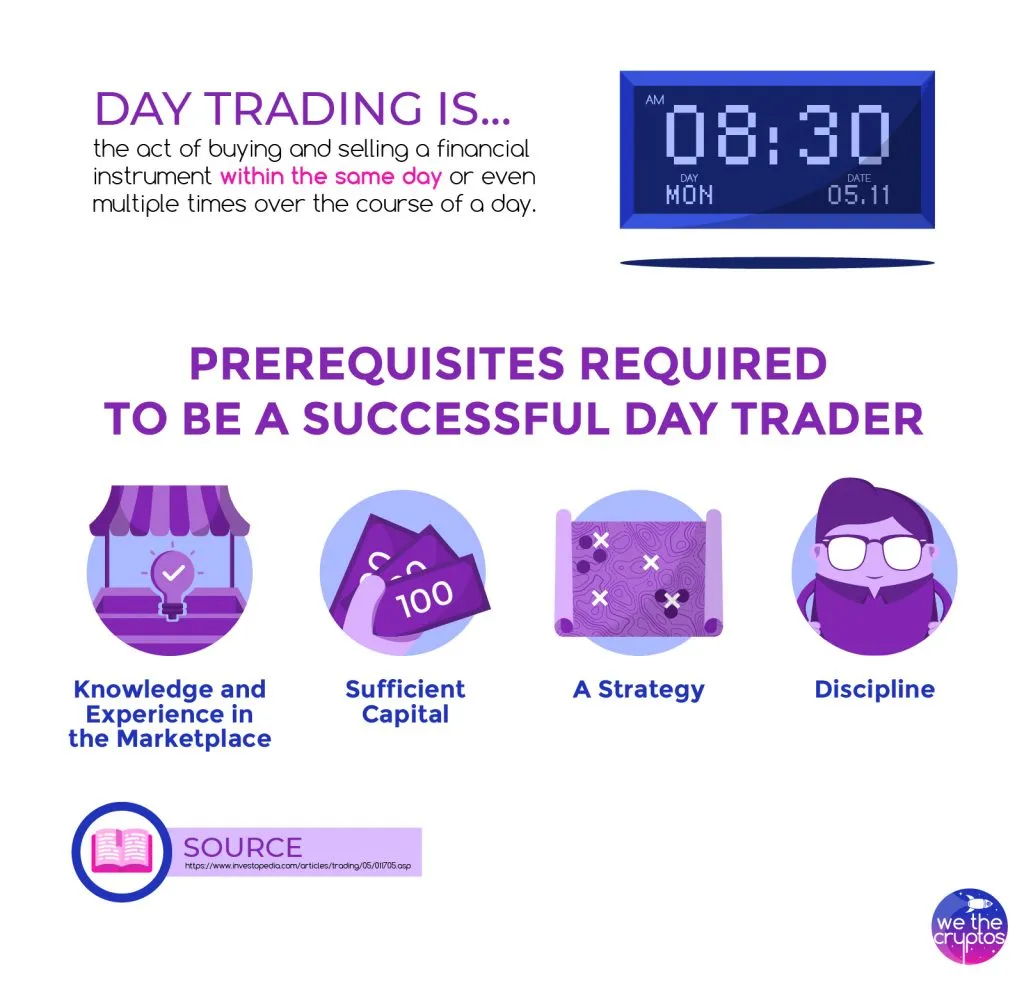
One of the more common forms, day-trading is the form of trading that happens all within a single trading day. It involves executing long and short trades to capitalize on the market price of the day. Basically, you conduct trades during the day and close all your trades by the end of the day to prevent open positions overnight.
The downside to day trading is that it’s very technical and has a very steep learning curve. It takes a lot of your time, so treat it as a full-time commitment and don’t quit a steady job on the hope that it will pay. You’ll need to watch multiple screens to spot trade opportunities and then quickly exploit them. It’s done day after day which requires a high degree of focus and concentration, not to mention the amount of knowledge needed to capitalize on opportunities.
Swing-trading
Compared to day-trading, swing-trading is kind of the opposite. You won’t really need to keep your eyes glued to your monitors and you won’t have to quit your day job. You can swing-trade on the side as long as you have capital you can afford to lose.
Swing traders hold open positions. They hold these positions over short periods of time. According to BitcoinMarketJournal, these positions can last from as short as overnight to as long as several weeks. Swing traders buy and sell bitcoins during significant raises and dips in bitcoin’s price respectively.
Comparing it once again to day-trading, swing traders run the risk of larger losses since they hold their positions for longer periods of time.
Alt-coin Flipping
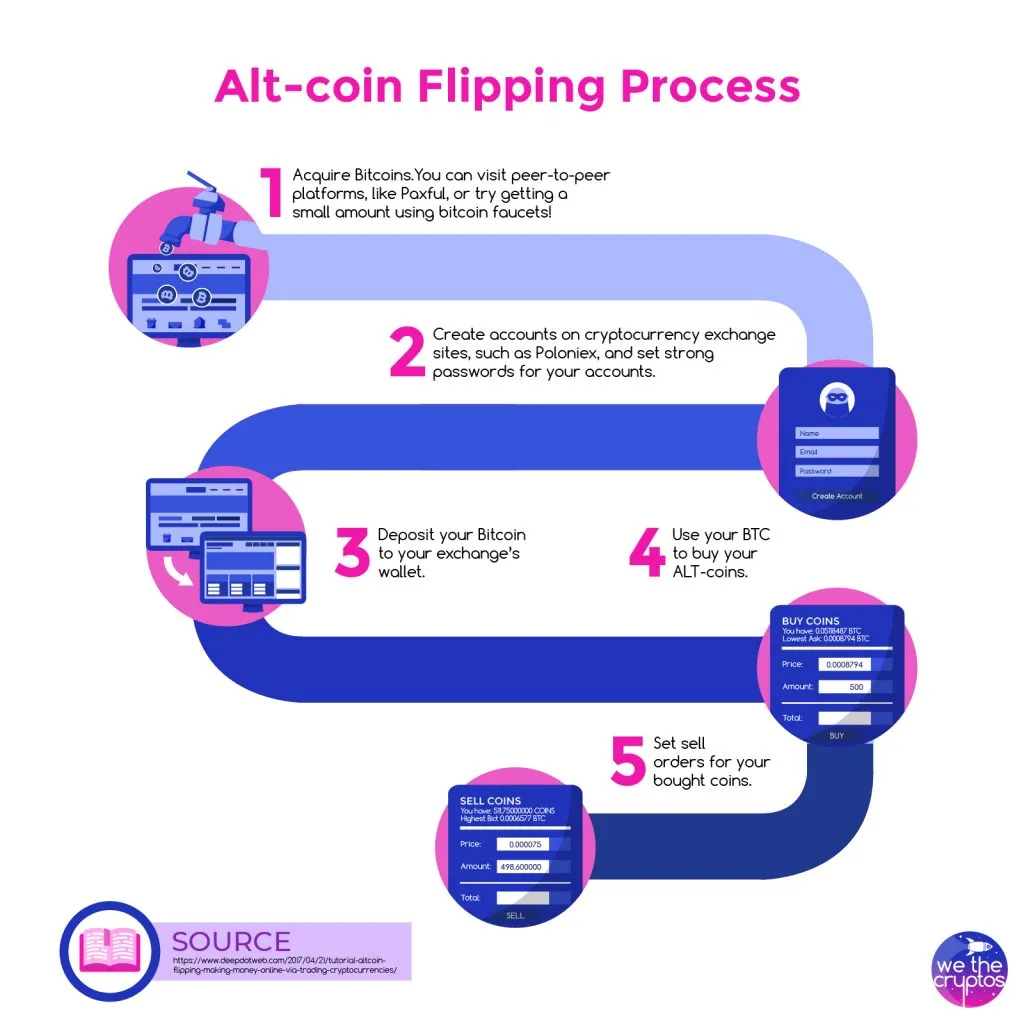
Since the birth of many new cryptocurrencies, “alt-coin flipping” has grown in popularity and is now one of the most common methods of trading. “Alt-coin flipping” refers to the trading of various altcoins in the hopes of profiting from price moves. Smaller coins are thinly traded and can swing hard in either direction. If you’re curious why there are so many of them, see why there are so many cryptocurrencies.
Related to altcoin flipping, you can also check how profitable altcoin mining can be. Bitcoin cash mining profitability can be something to look into.
If you’re planning to trade altcoins, note that many of these coins can only be bought with bitcoin, not fiat currencies. Also, if you’re going to use this strategy, make sure to keep track of all your trades via Excel or Google Spreadsheet. There are tons of bitcoin excel spreadsheet templates on the web to use. A related approach is bitcoin arbitrage, which looks for price gaps between markets.
Peer-to-peer trading
Over the years, peer-to-peer marketplaces like Paxful and Localbitcoins have grown immensely in popularity due to the rising number of payment options.
On these platforms, buyers and sellers find each other and trade on their terms guided by the platform of their choice. With the vast number of payment options, you can trade almost anything for bitcoin as well as sell your extra bitcoin for any of the available payment methods. An example of this would be to use your bitcoins to buy discounted gift cards that you can sell back. You could also stack the gift cards, buy a product with those gift cards, and then sell the product (you could turn your iTunes gift cards into a new iPad). Paxful specializes in gift cards, though it also has other payment options to choose from. It adds more to the mix than many other peer-to-peer marketplaces. Check that any platform you use is still operating and available in your region, and be careful with irreversible payments, since P2P scams are common.
For a side-by-side look, read our comparison of a traditional exchange and a P2P marketplace.
Using it in E-commerce
If you’re a business owner and are looking to accept bitcoin as a payment method, then there are a ton of easy ways to do so. There are apps, online payment intermediaries, or you could start small by putting up a small sign on your website saying that you accept bitcoins as payment. It’s as simple as registering yourself up for an online wallet and giving the wallet address out to your customers.
There are also affiliate programs out there that you can look at as a side income while you focus on your business. Earnings are never certain.
Exchanges
In comparison to peer-to-peer platforms, traditional bitcoin exchanges are more popular and more well-known since they’ve been around for a longer time. On these exchanges, buyers and sellers are matched via order book and a middleman is tasked to complete the task for them. They’re very easy to use and can provide more privacy as users rarely have to interact with their trade partner.
The downside is that since there’s a middleman, there are higher fees compared to a peer-to-peer marketplace.
Risks to understand before you trade
Bitcoin can move sharply within hours, and short-term strategies like day-trading and swing-trading magnify that. Most people who trade actively lose money at some point, so decide in advance what you can afford to lose and never trade with money you need for rent, bills or an emergency fund.
- Size positions small enough that one bad trade doesn’t hurt.
- Set an exit point before you enter, and stick to it.
- Count fees and taxes in your results. Gains may be taxable in the US, so keep records and ask a qualified tax professional.
- Store coins you aren’t actively trading in a wallet you control. Our guide to different types of crypto wallets explains the options.
New to all this? Start with things you should know before investing in bitcoin. This page is general information, not financial advice.
Which style suits you?
Now that you know the more popular forms of bitcoin trading, it’s time for you to decide which strategy suits you the most. Be sure to make use of all the bitcoin tools at your disposal. You can also look for bitcoin-friendly banks and it’ll make your trading experience much easier. When you’re ready to cash out, see how to convert bitcoin into cash.
Let us know which style of trading suits you the most! All of us here at We The Cryptos are bitcoin enthusiasts ourselves and we’d love the insight!
If you’re just starting out, HODLing is usually the easiest style to begin with. It needs no screen time and no technical analysis. It still carries the full price risk, though, so begin with a small amount.
Exchange or peer-to-peer marketplace
Where you buy matters almost as much as how you trade. Exchanges are the easier route, and you don’t have to deal with a counterparty yourself. The price for that convenience is fees, which are usually higher.
Peer-to-peer marketplaces give you more payment options. The trade-off is scam risk, and you have to manage it yourself.