DAG stands for Directed Acyclic Graphs and instead of working on the blockchain, they work in things called “tangles” in a new kind of system. At this point, we’ve all been introduced to the blockchain technology that came with the creation of bitcoin.
Basically, the blockchain is a record of data that cannot be tampered with. It’s managed by a cluster of computers that aren’t owned by a single entity. “Block” refers to the clumps of data per transaction that are secured and bound together using other cryptographic principles, hence “chain”. For years, blockchain has proven to be an innovative and lucrative technology to emerge with its near real-time updates of transactions. The one problem is that as the blockchain grows larger, the longer it takes to validate transactions. Some cryptocurrencies have already begun experiencing delays when it comes to the verification of transactions. This ends up resulting in higher fees and deflated expectations. This is where DAGs come in. Compared to the blockchain’s linear structure, DAGs are non-linear and actually promise that the larger their network is, the quicker they will validate transactions.
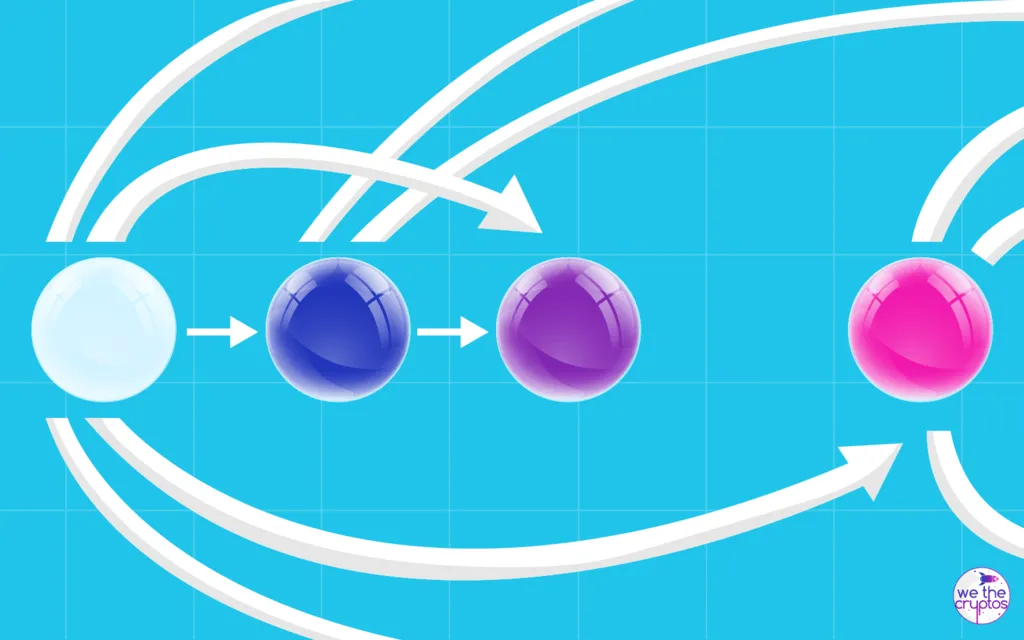
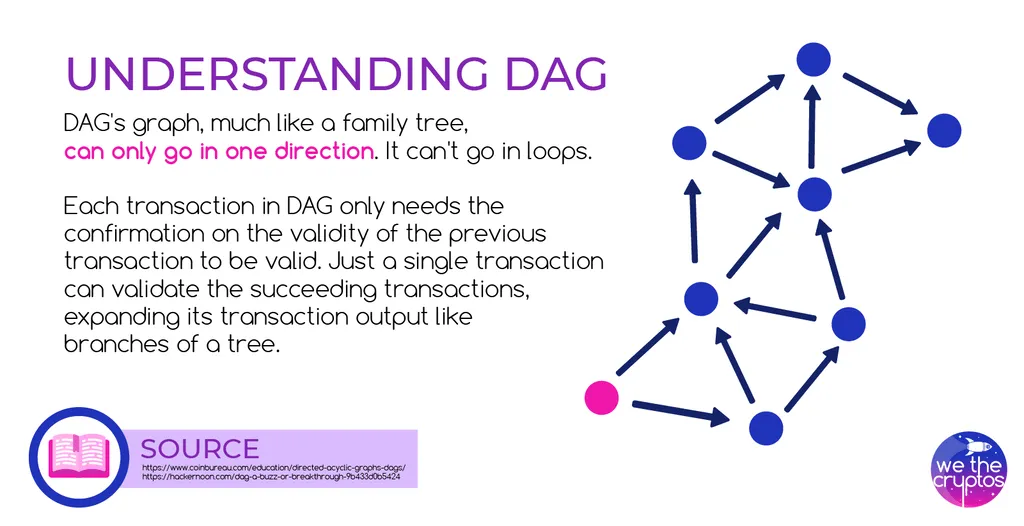
On the blockchain, the previous block is required for a new block to be created. This means that the process for a new transaction cannot begin processing until the previous one is completed. DAGs, on the other hand, only requires two other transactions to ensure the trust of the first to the present one.
The most popular DAG crypto is currently IOTA. IOTA stands for Internet of Things Application. The cryptocurrency addresses the transaction fees and scalability issues of the blockchain technology. How does it address the problems of blockchain technology? It gets rid of the block and the chain. We’re going to use IOTA as an example to further explain what a DAG is.
When it comes to transactions with IOTA, a transaction and all its information are stored as a node. A group of nodes then make a “tangle” – the IOTA equivalent of a blockchain. The information that is stored on these nodes includes the sender, the receiver, the amount, and the time sent. As soon as a transaction is added, it connects itself to two other nodes. When a node does that, it verifies the two nodes by checking if they conflict with other transactions of the network.
The advantages of DAGs
The computer that added the new transaction does a little bit of proof of work as well to complete the addition. This means that a lot of IOTA users contribute to making the network as secure as possible. This will eliminate the need for dedicated miners, removing any fees and expenses that come along with them.
The network speeds up as more transactions are added. This is because every time a new transaction is added, two older transactions get validated and approved by the network.
DAGs also do not use as much data as the blockchain network since all you need is a fraction of all transactions (the two nodes that your transaction attaches itself to) to validate it.
In theory, DAGs are a lightweight system that is quick when it comes to processing transactions. This makes it extremely scalable, at least compared to the blockchain.
The disadvantages of DAGs
Since the proof of work system on the tangle is very small scale, it isn’t as secure as the blockchain. IOTA users are vulnerable to a 34% attack which means that if an attacker has a computing power of more than 34% of the network, they can send and approve fake transactions and eventually take over the tangle. The network is especially vulnerable when it’s still small with very low computing power. The fix to this is that the IOTA team has implemented a coordinator node that will manually approve transactions. Once the network is big and strong enough to withstand attacks, the coordinator node will be removed. Of course, this then removes decentralization, at least for the beginning.
The technology is also still very new and unproven. It’s going to have a difficult time with decentralization. The fact that it’s so new and hasn’t yet proved itself means that IOTA (and DAGs) are going to pull out all the stops to convince us that it’s better than the blockchain. It’ll also have to prove itself to cryptocurrency enthusiasts before any of them invest in it.
Bitcoin vs. IOTA (Blockchain vs. DAG)
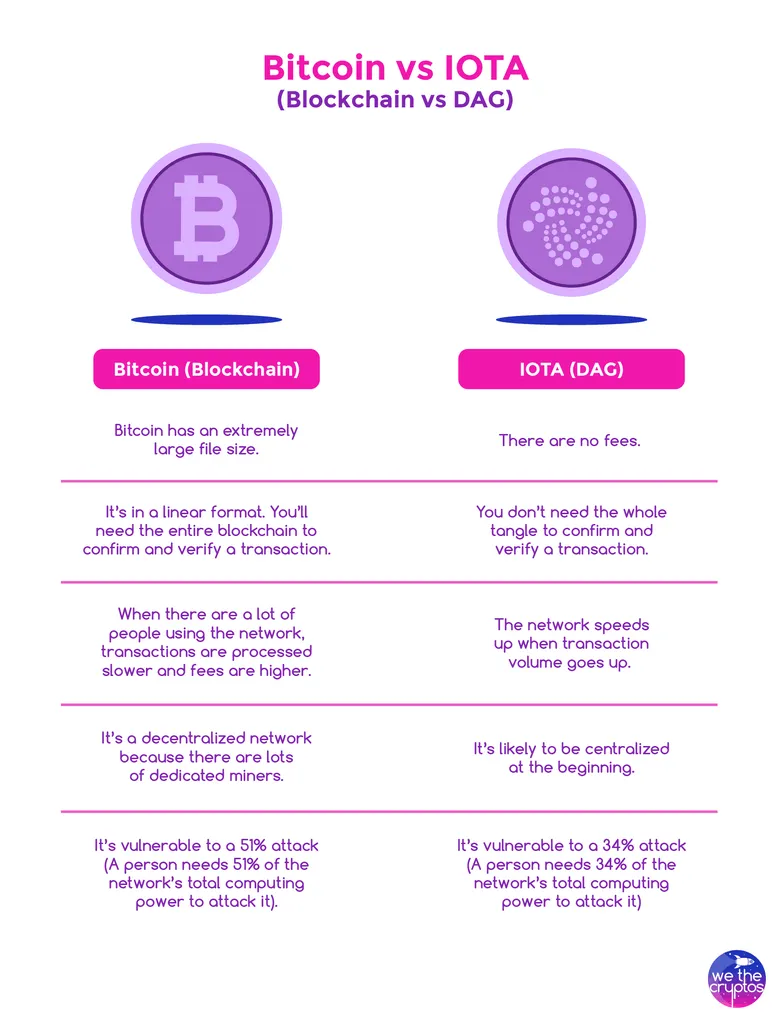
Now that we more or less know what DAG cryptos are, we can properly compare the different kinds of technology presented to us.
It’s clear that DAG has a lot of advantages over the existing blockchain technology. Mainly, the transaction speed and the fees (because of the speed) that incur.
The verdict
Despite that, the technology is still very new and it still has to prove itself. DAGs have immense potential but as we all know, the blockchain has been tried and tested. If quantum computing comes to mainstream, the blockchain technology as it stands will not be secure anymore. In such a case, DAG technology may provide a silver lining.
Blockchain technology has been with us for 10 years now and it’s only recently that people have started to complain. DAGs have potential to overthrow this, but we’ll all have to wait and see if everything pans out.
What do you think about DAGs? Do you think it’s going to take over the blockchain technology? We’d love to hear your thoughts! Let us know in the comments section down below!